Poor reporting systems and extracting some value
Attribution error in vaccine injury reports

The 2 main problems with VAERS etc
VAERS, Yellow Card etc suffer from 2 major flaws, one of which is that not all adverse events are reported. The other is attribution error; where a report has been filed after an adverse event that the doctor thought could have been caused by the vaccine, but when in fact it just happened to occur after the vaccine, but was unrelated to the vaccine. There are other more minor issues with our reporting systems, but I won't cover them here, except in passing.
Under-reporting and what is URF?
URF is Under-reporting factor - the number you use to multiply vaccine adverse events by, in order to get an estimate of how many real events there might be. The need for an URF is one example of why the reporting systems are flawed. This doesn't warrant writing off reporting systems like VAERS in the US or yellow card in the UK - it's just that to bring some utility to them, work arounds have to be used. For clarity, URF = 100/Reporting rate as a percentage of actual events.
The URF estimate for these new vaccines, ranges from 5 to 100 with 40 being a likely conservative figure for underreporting of deaths. Each category of vaccine adverse event (VAE) might have a different value, but this article is not about the actual number. Steve Kirsch, Mathew Crawford and Jessica Rose have written good pieces on this. Let's park the question of what the actual value of URF is, for now.
Attribution
How do we know if the jabs actually cause the adverse event; after all if there have been a lot of vaccinations administered recently, there is a chance that a death is just a death that would have happened in the absence of the jab. This article is mainly about misattribution.
Let's go through the possibilities, but first a message from a doctor friend:
"But it's tricky...
Eg I’ve had a myocarditis and a brain clot case. Both about 2 weeks after vaccine- could easily be related. But might not be.
So can’t go on individual cases.
have to look seek a population temporal rise before and after vaccines rolled out. But that’s not easy because Covid also causes same side effects.
Or compare vaccinated vs non-vax side effects - but that’s not easy because different groups - age etc
The epidemiology is fiendishly complicated! Unless one’s got a tame medical statistician I can’t see it’s poss to tease out."
Should he report it in VAERS/YC or not?
So the myocarditis and brain clot could be something other than the jab. If it is a young person the myocarditis could just be an unlucky rare case that is not jab related. The clot, for someone under 50 is extremely rare unless they have a pre-existing condition. So the doctor, in both cases, could rationalise that it is not possible to ascertain causation and therefore filling out a yellow card report is unhelpful.
In not filling out the vaccine injury report, they will have inflated the "safe" part of "safe and effective" mantra behind the vaccination campaign. The lack of a report will have zero immediate effect on the patient, and save around half an hour of the doctor's time, which can be spent helping other patients, or another few holes at the golf club. No harm done.
The converse is filling out the report, knowing that it won't make any difference to the patient, knowing that it might promote vaccine hesitancy, which could possibly lead to more people suffering with Covid. I think most doctors during the vaccination campaign have been acting in good faith, and that they believe wholeheartedly the vaccines to be safe and effective. However, another factor could be in play, at an almost unconscious level. Financial incentives can’t be ignored, and some GPs will know that hesitancy to have the jab will lead to reduced jab booster bonuses over the next few years (a not insignificant value in the context of a reasonable sized surgery). This last factor may be a glib suggestion, but not many of us are immune to the effect that financial compensation has on our behaviour.
On an individual level, reporting in one of the national reporting systems won’t help that individual. On an individual level, that report can’t be relied on to be totally representative because of misattribution. It is only when you have thousands of reports, a pattern emerges (or not). The problem is, every suspected VAE has to be flagged up to build the evidence base; the fact that this doesn’t happen in reality because of the above reasons means that a way of estimating the true number of reports is needed.
How the imperfect reporting systems can be useful
The reporting systems should be acting as early warning systems - showing up any strong signals. The raw number of reports is less important than the relative number of reports. What do I mean by relative? Relative to what?
Relative to previous vaccines:
By comparing to conventional vaccines, which in the main have proved to be safe over many years, we can see if there is anything to be concerned about; after all this is the first time we have used this new mRNA or DNA vector vaccine tech in whole populations. Of course there has to be a denominator for us to ascertain how safe these new vaccines are compared to conventional vaccines. Vaccine Adverse Events (VAE) per dose given has to be used rather than absolute numbers, because a lot of jabs have been given in 2021/2022. By comparing to previous vaccines, it allows us to reach a factor by which these new jabs are more or less safe, which gets around the URF, as broadly the URF factor will be similar for both conventional and these new vaccines; again this may not be entirely true, but if the signal is large enough, then this difference in URF will be less important.
An illustration of how the new vaccines compare with conventional vaccines is shown below (but without the all important denominator, this is just an alarming looking signal as it stands). The actual increase in risk per dose from these new vaccines has been mentioned in other articles, this one is a letter from the BMJ:
https://www.bmj.com/content/372/bmj.n393/rr-3
“If you compare flu vaccine reported deaths in 2020/21 (193m doses) to the two months of data from COVID 19 vaccines (35m doses as of Feb 4th), then the tally is as follows:
Dec 2020 - Feb 4th 2021 COVID 19 vaccine deaths: 653
Sept 2020 - Jan 31st 2021 Flu vaccine deaths: 20 (Twenty)
Using basic math, that means that the rate of deaths reported following the COVID 19 vaccine is 180 times that of flu vaccine deaths.”
So the signal looks strong on the graph below, but without comparing the actual rate (events per dose) you can’t make a meaningful comparison. The BMJ article above puts things into context somewhat, and shows that the signal is both strong, and true, rather than just a function of large numbers of covid vaccines administered recently.
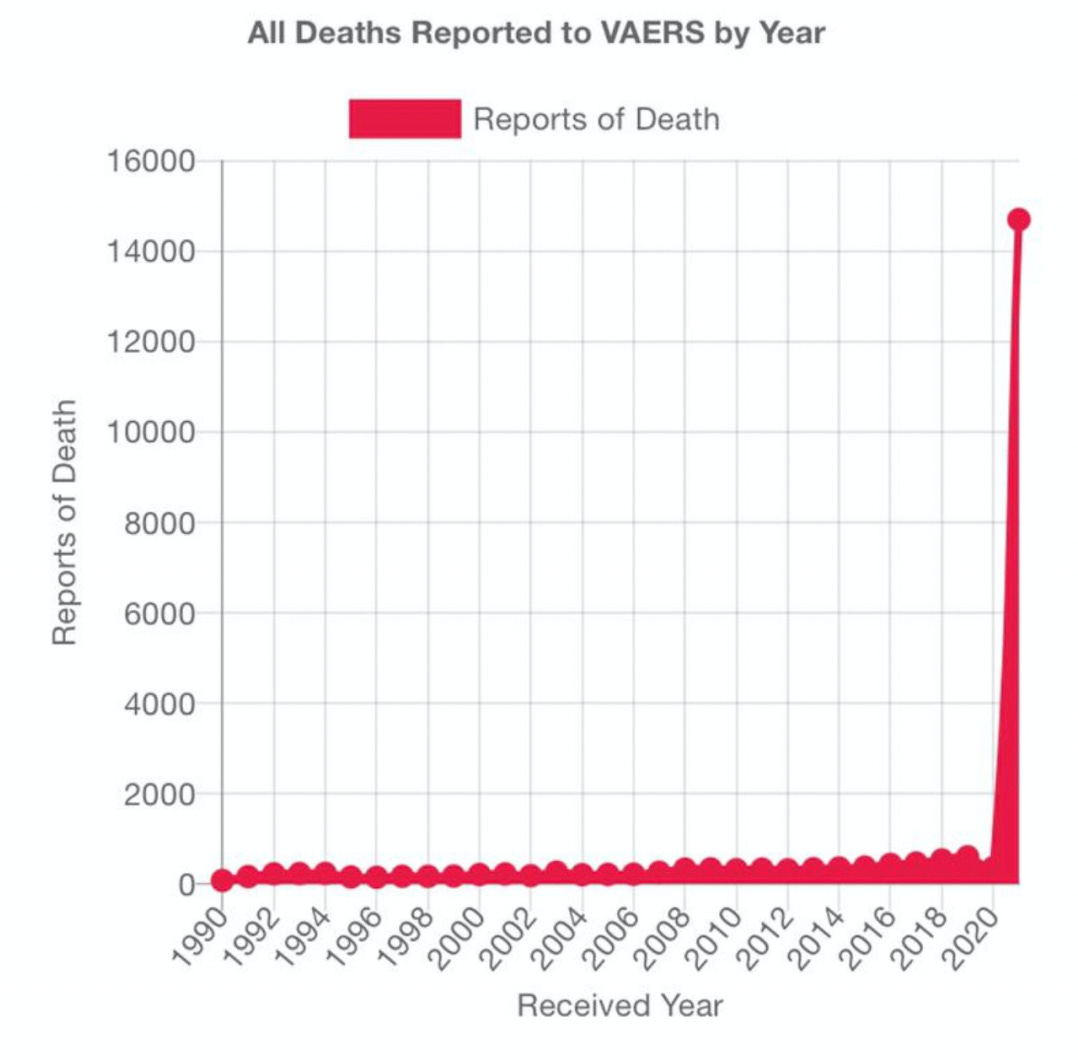
How do we drill down to the thorny question of whether the jab has caused the event, or the event just happened to occur after the jab with no causation?
We know that just by filling in a VAERS report doesn't make the causal link valid, but it does start the ball rolling, and allows for further investigation. Ideally a report would be mandatory for any condition less than 60 days after the jab, because most short term VAEs occur inside that time window. As this is not the case, we have to assume that there will be a random spread of conscientious doctors and nurses who understand the reasons a VAERS (or equivalent) report is important. So the sample size is far smaller than it should be, but hopefully contains a representative selection of events that MIGHT have been caused by the jab.
Temporal Relationship
Now we have data of VAEs across many categories, such as Anaphylaxis, myocarditis, GBS, Death.
For each category we can plot events on the Y axis and days taken after the jab for the event to occur on the X axis (horizontal time axis). Here is an example for death after the jab:
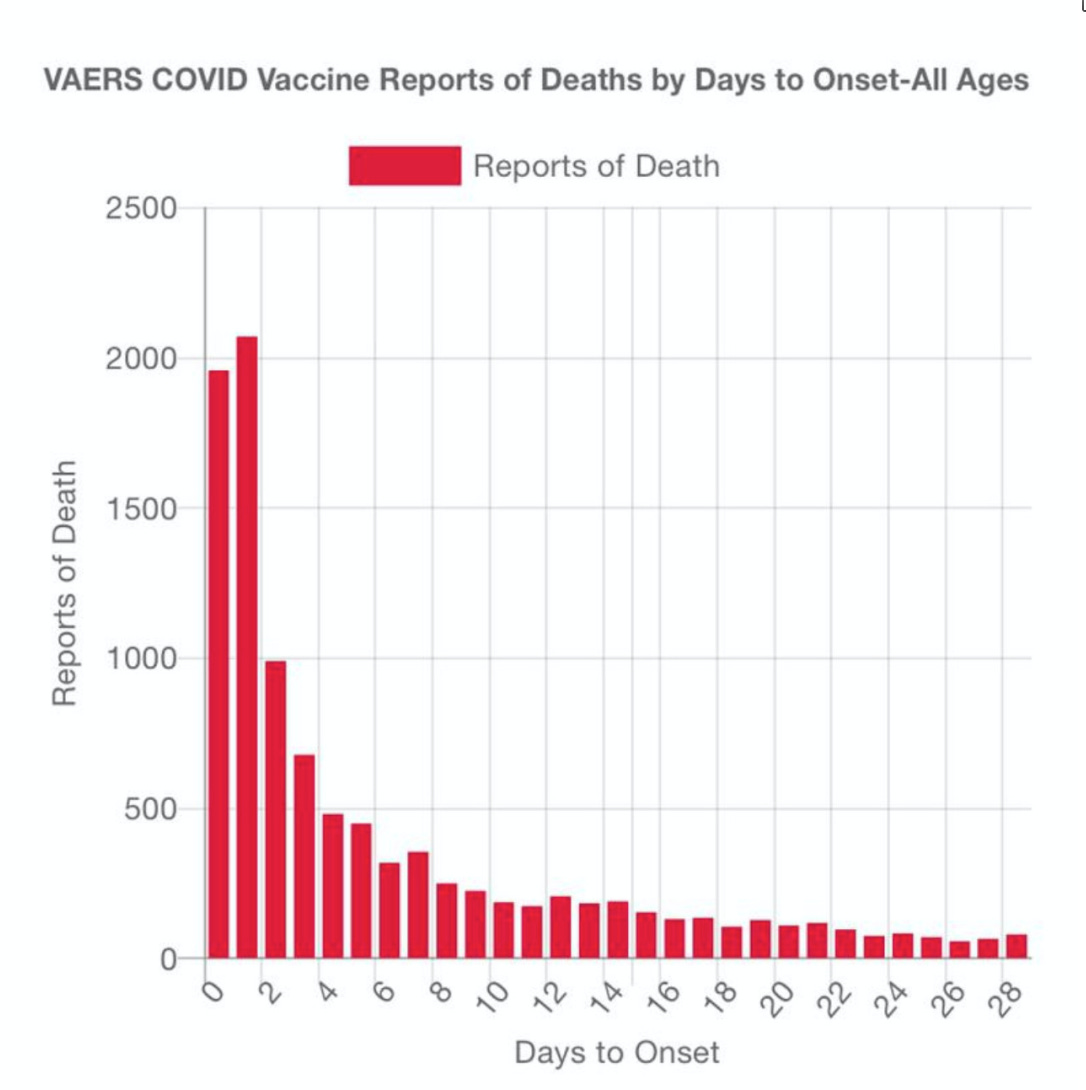
If the event occurred by chance, after the jab but not related to the jab, you would expect all the bars to be the same height. If you see the sort of graph shown above, you can infer there is a strong temporal relationship - that is it is likely the jab caused the event, because there is a far higher VAE count straight after jab, with a declining count away from the date of jab. Temporal relationship is not the only criteria that leads you to believe causation, but it is a strong and robust one. You can never see this relationship in individual cases, because these are just anecdotes, but when you look at thousands of events, you can build a picture of what is happening such as in the graph above. For completeness, Bradford Hill Criteria build up the causation hypothesis, including other things such as plausible mechanism. Here is a link to an explanation of Bradford Hill Criteria:
https://en.wikipedia.org/wiki/Bradford_Hill_criteria
and here is a link how that explanation relates to the new vaccines:

How to subtract the underlying rate from the reports
A simple but crude way is to simply look at the chart above, and work out when the bars flatten out, on the right side of the chart. At this point it looks like the effect of the jab has died out, and we are left with the background (underlying) rate. If you have 60 days of data, that is, reports have been filed for any event happening within 60 days of the jab, then most of the short term effect from the vaccine has already happened, with few events occuring because of the jab. You then see the height of those flat bars, say 50 in the example above, and draw a line at 50. The area above the line will represent events caused directly by the jab. To get an estimate of actual numbers you then need to multiply by the URF; ie if the URF is 20 (only 5% VAEs are reported) then multiply the events caused by the jab by 20. This then allows you to do a risk benefit analysis on the vaccines. The method of calculating the URF is here:
https://www.skirsch.com/covid/Deaths.pdf
Click on the link above to see how Steve Kirsch, Jessica Rose and Mathew Crawford estimate the underreporting factor and cross check it around ten different ways.
Here is a follow up article with corroboration from another source:

A better way of analysing the scale of the problems
So despite the flaws built into VAERS and the other reporting systems, they are good at flagging issues. Once you have a selection of categories (around 20 or so), you should then look elsewhere to ascertain the scale of the issue. I've suggested a crude method above for calculating numbers caused by the jab using VAERS data, but surely there is a more robust method: One method is described in the Steve Kirsch article above; in essence it compares the VAERS anaphylactic reports to the raw anaphylactic reports that are mandatory post vaccination. They can’t be ignored because they occur at the vaccination site. Another possible method is as follows:
Many countries (or country's militaries) have patient databases, or even rates for each category of illness from the above list. Once you have flagged up potential events in VAERS, you take the rates per population for the each category during the vaccination programme, month by month and compare with the 5 year average. You could even include 2020 in the 5 year average when most countries had covid injuries, which would help reduce the over estimation of vaccine injuries, as some VAEs overlap with symptoms from the vaccine. In comparing the 2021 months with the 5 year average, you get a raw number per population which is largely free from attribution error (causation vs correlation), and underreporting.
By having a raw number of injuries caused by the vaccine, you can then go back into VAERS and get a sense of the scale of underreporting in each category. This is something Steve Kirsch, Jessica Rose and Mathew Crawford have done to arrive at a conservative figure of 41 as the best estimate of URF.
This is not an exact science, but is a useful method to evaluate the risk side of the equation. It is the best we have.
Imagining a robust reporting system
Many people used the Tim Spector ZOE app throughout the pandemic in the UK to log any covid symptoms. I believe it was also used to log vaccine related issues. We can only imagine back in early 2021, a similar ZOE style app we we could have been encouraged to use, that asked us each day after the vax whether we had any issues. It would take less than a minute a day, and not rely on us remembering to report any issue to the doctor. There would be no filtering from a doctor, unless they got a notification from the app to contact us if the issue was of a serious nature. In this case, the issue would be latched and a follow up from the doctor would be done automatically every day in case it worsened. We would capture v good data, and it would help mitigate against the risk of VAE. Blood thinners could be administered if people reported swollen legs or headaches. Scans could be scheduled, D-Dimers could be ordered to check micro-clotting levels in the blood. It would transform from
"the doctor dismissed it as a rare non related event”
to
"I got a call from the doctor earlier to report to the hospital for a check of my blood pressure and a d-dimer test; he thinks I may have micro-clots in my lungs that is causing my breathlessness. He says it is important to rule it out as sometimes the hypertension can lead to heart failure”.
The shift would go from what seems like suppression of vaccine injury narrative to active monitoring and willingness to report and sort out issues, and if necessary, take the bold step of halting the vaccine programme if the data shows this is warranted.
What went wrong?
So why could a similar app not be rolled out to the world with all governments encouraged to get their citizens to use it? Very few issues would have slipped through the net, which could have allowed an accurate picture of the safety of the vaccines and saved lives too. They had a good 9 months to code the app and establish reporting protocols - it was never done. We relied on existing passive reporting systems that were not up to the job, either because they are too clunky and slow to use, or subject to the inherent problem of a such reporting systems, that misses most issues. Also the negative incentives as mentioned above to not report are built into the vaccine administration framework. If it is possible for me to imagine a simple app in a couple of minutes, why didn't the big brains develop such a system in parallel with the vaccine trials - a fraction of the work and cost of vaccine development, for great benefit. Why was this not done, given that we had plenty of knowledge of the limitations with the existing reporting systems? In 2018 Stanford did a study on the underreporting rate, and came up with a figure of only 1% to 10% of adverse events get reported. The reason why a good robust reporting system wasn't developed at a time where it was most crucial, is a far more speculative subject than the nuances of reporting rates etc, but if you were concerned with public health, a good robust reporting system should have been at the top of the list.